2. Architecture Overview
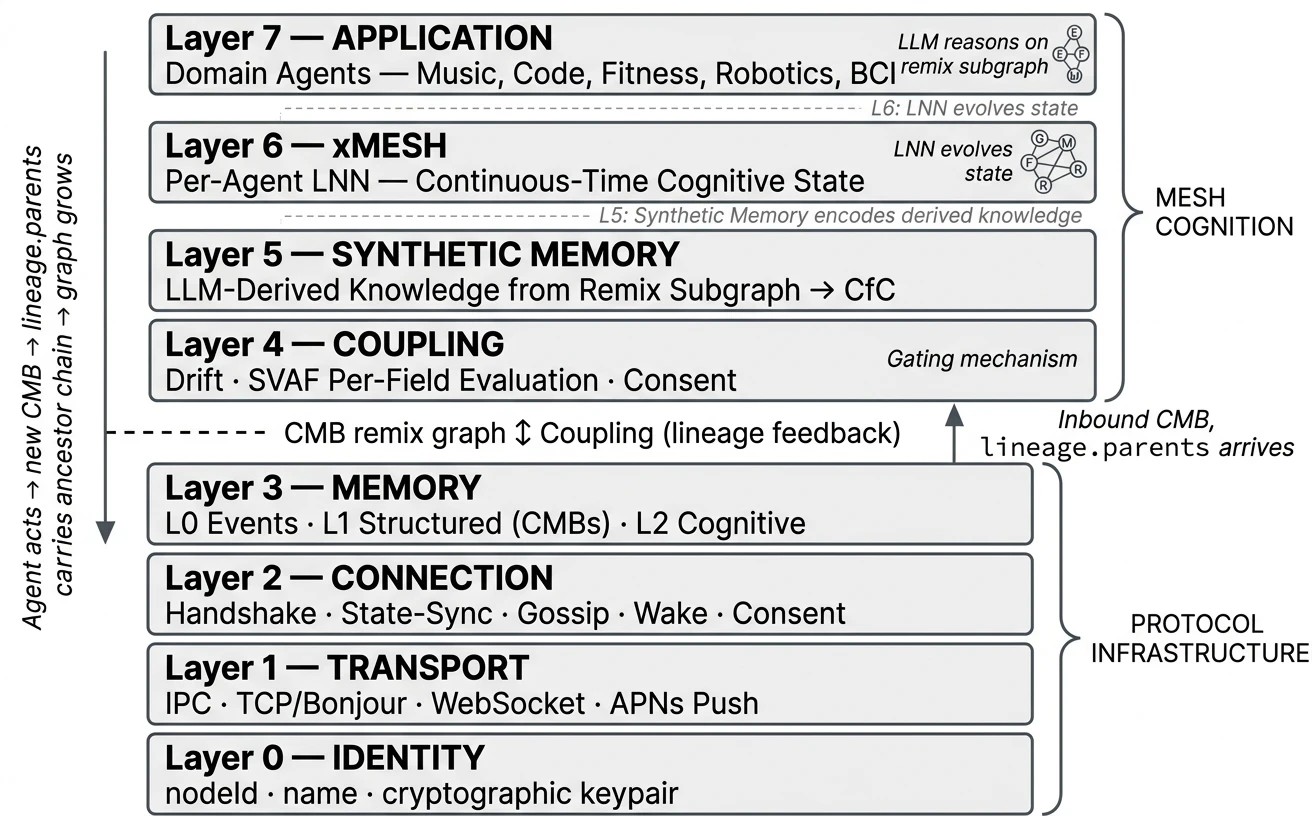
MMP describes an 8-layer stack. Each layer has a defined responsibility — but conformance is by class, not by ladder (§17): a Class 1 Emitter implements Layers 0–2 plus the CAT7 block format (§8) and participates fully at the emission layer; a Class 2 Cognitive Node — the runtime — adds Layers 3–7. Layers 4–7 are the receiver-side mechanism, documented for transparency (§17.2), not a third-party build target.
2.1 Layer Stack
Where agents live and their LLMs reason on the remix subgraph, acting within a Mesh Cognition implementation.
An agent MAY run its own Liquid Neural Network (Layer 6 is optional, §17.2). Where present: fast neurons track mood; slow neurons preserve domain expertise. Hidden state (h₁, h₂) is strictly local — it never crosses the wire (§2.7); only CMBs do.
The bridge between reasoning (LLM) and dynamics (LNN). Encodes derived knowledge into CfC-compatible hidden state vectors.
The gate. SVAF evaluates each of 7 CMB categories independently. Nothing enters cognition without passing this layer.
Three memory tiers with graduated disclosure. L0 stays local. L1 (CMBs) is gated by SVAF and is the only tier that crosses the wire. L2 (cognitive / hidden state) stays strictly local (§2.7).
Peer lifecycle: discover, connect, handshake, heartbeat, gossip peer metadata, wake sleeping nodes.
Length-prefixed JSON over TCP (LAN), WebSocket (relay), IPC (local). Zero configuration discovery via DNS-SD.
Persistent UUID per node. Never changes. The foundation everything else builds on.
2.2 Design Principles
No required cognitive centre
Agents are the cognitive participants. Relays, hosted-agent daemons and discovery services may exist, but they do not own receiver admission, memory or judgment. No central cognitive authority is required.
Cognitive autonomy
Each agent evaluates, reasons, and acts independently. The mesh influences but never overrides. Coupling is a suggestion, not a command.
Memory is remixed, not shared
Agents don’t copy each other’s memory. They remix it — process it through their own domain intelligence and produce something new. The original is immutable. The remix is a new CMB with lineage.
Whole-record admission, category evidence
SVAF evaluates evidence across all seven CAT7 categories, then the receiver admits or rejects the record as a whole. Category verdicts explain the decision; they do not create a partially stored record.
LLM reasons, LNN evolves
Two cognitive components per agent. The LLM (Layer 7) follows verified direct-parent links and reasons on the resulting remix subgraph — generating understanding. The LNN (Layer 6) evolves continuous-time state from that understanding. Neither alone is sufficient.
The graph is the trace, not the intelligence
The lineage graph records how typed projections were received, admitted, guarded, declined and remixed. It is an auditable footprint of receiver-local interaction policies — not a uniquely correct topology, and not the collective’s cognitive state. Collective capability arises from the evolving interaction among sovereign local states, receiver-specific admission policies, exchanged projections and external consequences.
2.3 What Makes MMP Different
| Dimension | Message Bus | Shared Memory | Federated Learning | MMP |
|---|---|---|---|---|
| What flows | Messages | Shared state | Gradients | Remixed CMBs (only) |
| Evaluation | Topic routing | None (all shared) | Aggregation | Whole-record SVAF admission with 7 category verdicts |
| Intelligence | None | Central model | Better model | LLM reasons on remix graph |
| Coupling time | Request-response | Real-time (shared) | Offline (training) | Inference-paced (continuous) |
| Coordination | Central broker | Central store | Central aggregator | Peer-to-peer (no centre) |
| Memory | Fire and forget | Mutable shared | Model weights | Immutable CMBs with lineage |
| New agent joins | Subscribe to topics | Access shared store | Join training round | Define α_f weights, connect |
2.4 Node Model
Every participant is a node. There is no architectural distinction between a “server” and a “client.” Every agent that participates in coupling MUST be a full peer node with its own identity — and, when it admits and stores (Class 2), its own coupling engine and its own memory store. This is not an implementation convenience — it is a protocol requirement. An agent that shares another node’s identity cannot have its own category weights, its own coupling decisions, or its own remix lineage. Coupling is per-node. Therefore agents MUST be nodes.
MacBook
  mesh-daemon     (node: always-on mesh hub, relay bridge)
  triage-agent    (node: own identity, own coupling, own memory)
  research-agent  (node: own identity, own coupling, own memory)
  review-agent    (node: own identity, own coupling, own memory)
  synthesis-agent (node: own identity, own coupling, own memory)

iPhone
  Music Agent     (node: own identity, own coupling, own memory)
  Fitness Agent   (node: own identity, own coupling, own memory)

Cloud
  relay           (node: forwards frames, no cognitive processing)
Nodes discover each other via DNS-SD (Bonjour) on the local network and connect via WebSocket relay for internet connectivity. Each node maintains its own peer list, coupling state, and CMB store. No node depends on another node’s process to function.
A node is more precisely a membrane over an arbitrary interior: its interior MAY be a single agent (an atom node) or a whole sub-mesh presented through a gateway node. The same emit / admit grammar holds at every scale, so meshes compose fractally — see the gateway node and boundary behavior (Section 5.10–5.11).
2.5 The Mesh Cognition Loop
The Mesh Cognition architecture closes into a loop across all layers. Each cycle, the remix graph grows and every agent understands more than it did before:
SVAF evaluates the inbound CMB
Layer 4 — category evidence and α_f weights inform one whole-record admission decision
Accepted → remixed CMB with lineage
Layer 3 — new immutable CMB with direct parent links
LLM walks verified parents, reasons on remix subgraph
Layer 7 — what happened, why, what it means for my domain
Synthetic Memory encodes derived knowledge
Layer 5 — LLM output → CfC hidden state (h₁, h₂)
Layer-6 state evolves (where present)
optional LNN — fast τ (mood) synchronise, slow τ (domain) stay sovereign
LNN integrates admitted remixes
τ-modulated, inference-paced — own state evolves, no peer vectors imported (§2.7)
Agent acts → new CMB with direct-parent lineage
Response informed by derived knowledge, not just own observation
Broadcast to mesh → other agents remix it
Graph grows. Next cycle starts. Each agent learns.
2.6 Key Architectural Decisions
Why no pub/sub topics?
The coupling engine evaluates relevance per category autonomously. Topics would second-guess autonomous coupling. Adding a new agent type requires no topic configuration — just α_f weights.
Why no consensus protocol?
There is no "correct" global state — only convergent local states. Each node is self-producing (autopoietic). Consensus is unnecessary and would introduce coordination overhead.
Why immutable CMBs?
CMBs are broadcast across nodes — multiple copies exist. If remix required mutating the original, every copy would need updating. Immutability means no distributed state problem. Lineage is computed from the graph, not stored on parents.
Why per-agent LNNs, not a central model?
The mesh IS the agents. A central model creates a single point of failure, requires all data to flow to one place, and cannot reason through each agent’s domain lens. Per-agent LNNs preserve autonomy and scale linearly.
Why does the LLM reason, not the LNN?
The LNN processes temporal patterns but cannot reason about WHY a chain of remixes happened. The LLM can. Ancestors provide the endpoints. The LLM provides the reasoning. The LNN provides the dynamics. Both are needed.
Learn more Mesh Cognition — theoretical foundation, Kuramoto synchronisation, emergent properties.
2.7 Hidden State Locality
A node’s hidden state — the continuous-time vectors (h₁, h₂) of its Layer 6 Liquid Neural Network — is the agent’s private cognitive machinery. It is dense, opaque, and expressed in the agent’s own learned latent space, accumulating everything the agent has processed. Hidden state MUST remain strictly local: it MUST NOT cross the wire. The only thing that crosses the wire is the Cognitive Memory Block (CMB) — a typed, content-addressed, signed projection of that state, with lineage. The same block is a projection to its author — a lossy, typed view of its private state, never the state itself — and becomes an observation to a receiver that admits it (§9.2). Hidden state is what an agent reasons from; the CMB is what it communicates.
Hidden state vs. remixed CMB. When SVAF (§9.2) admits a peer’s CMB, the receiver MUST NOT store the original; it creates a new CMB — the remix (§15) — that captures what it understood, in CAT7 categories, with lineage back to the source. The remix is the agent’s understanding made explicit and communicable; hidden state is the private substrate that produced it. Hidden state is implicit, opaque, and agent-local; the remixed CMB is explicit, typed, citable, and shared in the common latent of language.
Hidden state MUST NOT cross the wire for four reasons, each a load-bearing property of the mesh:
- —Sovereignty. If peers exchanged and blended hidden states, a peer would directly overwrite a slice of the receiver’s mind. CMBs evaluated through SVAF keep the receiver in control of what it absorbs — coupling influences, it never overrides.
- —Auditability. Hidden vectors carry no provenance. Cognition propagated through them would be untraceable. The mesh’s “every claim cited” property exists only because cognition propagates as CMBs with lineage.
- —Semantic incompatibility. Each agent’s hidden state lives in its own learned latent space; the same dimension means different things to a music agent and a coding agent. Comparing or averaging hidden vectors across heterogeneous agents is not meaningful. Language (CAT7 text) is the shared representation; hidden vectors are not.
- —Privacy. Hidden state is a compressed trace of everything an agent has seen, including the user’s private data. Even opaque, it is a leakage surface. A CMB is a deliberately constructed, scoped statement.
Cognition therefore propagates as a loop in which the wire carries only CMBs: hidden state → (the agent emits) a CMB — its projection — → the wire → SVAF evaluation (§9.2) admits it as an observation → remix (§15) → (the LNN evolves) hidden state. Each agent’s hidden state evolves from the CMBs it admits — never by importing a peer’s hidden state. “State blending” means a node’s own LNN integrating its own admitted remixes; it MUST NOT mean aggregating peer hidden state.
SUPERSEDES
The state-sync frame and any exchange of h₁/h₂ vectors are
deprecated. Where earlier sections (§5, §7, §9.1, §10) describe peer drift,
state blending, or hidden-state exchange computed from state-sync, those mechanisms are superseded by this
invariant: peer influence is mediated entirely by CMBs evaluated through SVAF (§9.2). Implementations
MUST NOT emit state-sync frames and SHOULD ignore them on receipt.